Vacuuming is one of the most labor-intensive tasks in any commercial cleaning program. It is also one of the most consequential for indoor air quality, occupant health, and the long-term appearance of your carpeted surfaces. Most facilities are still running it with the same equipment they have used for years — upright vacuums that are slow, hard to maneuver, and, in many cases, push more airborne particles back into the environment than they capture.
Commercial backpack vacuums, led by manufacturers like ProTeam, have changed the calculation. They cover more floor per hour, filter more effectively, and reduce physical strain on cleaning staff. If you have not evaluated backpack vacuums for your facility, this post walks through why they are worth the investment.
Why Indoor Air Quality Starts with Your Vacuum
Most people think of indoor air quality in terms of HVAC systems, filtration, and ventilation. Those systems matter. But the vacuum is the primary tool for removing the dry particulate contamination that accumulates on carpeted surfaces and contributes to airborne particle counts throughout a building.
Standard upright vacuums with basic filtration capture large particles effectively, but they allow fine particles — dust, pollen, mold spores, skin cells, and fine soil — to pass through the exhaust. Those particles are then suspended in the air and eventually settle on surfaces or are inhaled by building occupants. In facilities with carpeted common areas, conference rooms, corridors, and offices, the cumulative effect on air quality is significant.
HEPA (High Efficiency Particulate Air) filtration captures 99.97% of particles at 0.3 microns and larger. For commercial facilities with occupants who have respiratory sensitivities, for healthcare environments where infection control is a priority, and for any building during allergy season, HEPA filtration is not a luxury — it is a basic expectation.
The ProTeam GoFit backpack vacuum and the Super CoachVac series are designed around this standard. They use a four-level filtration system that captures fine dust at each stage before the air is exhausted back into the room.
The Speed Advantage: How Backpack Vacuums Change Cleaning Productivity
The productivity case for backpack vacuums is well documented. Industry studies have consistently shown that trained operators using backpack vacuums clean 40% to 50% faster than operators using comparable upright vacuums on the same floor area.
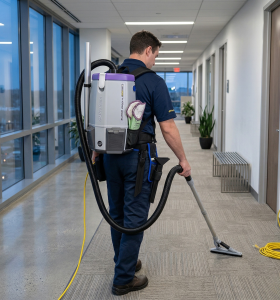
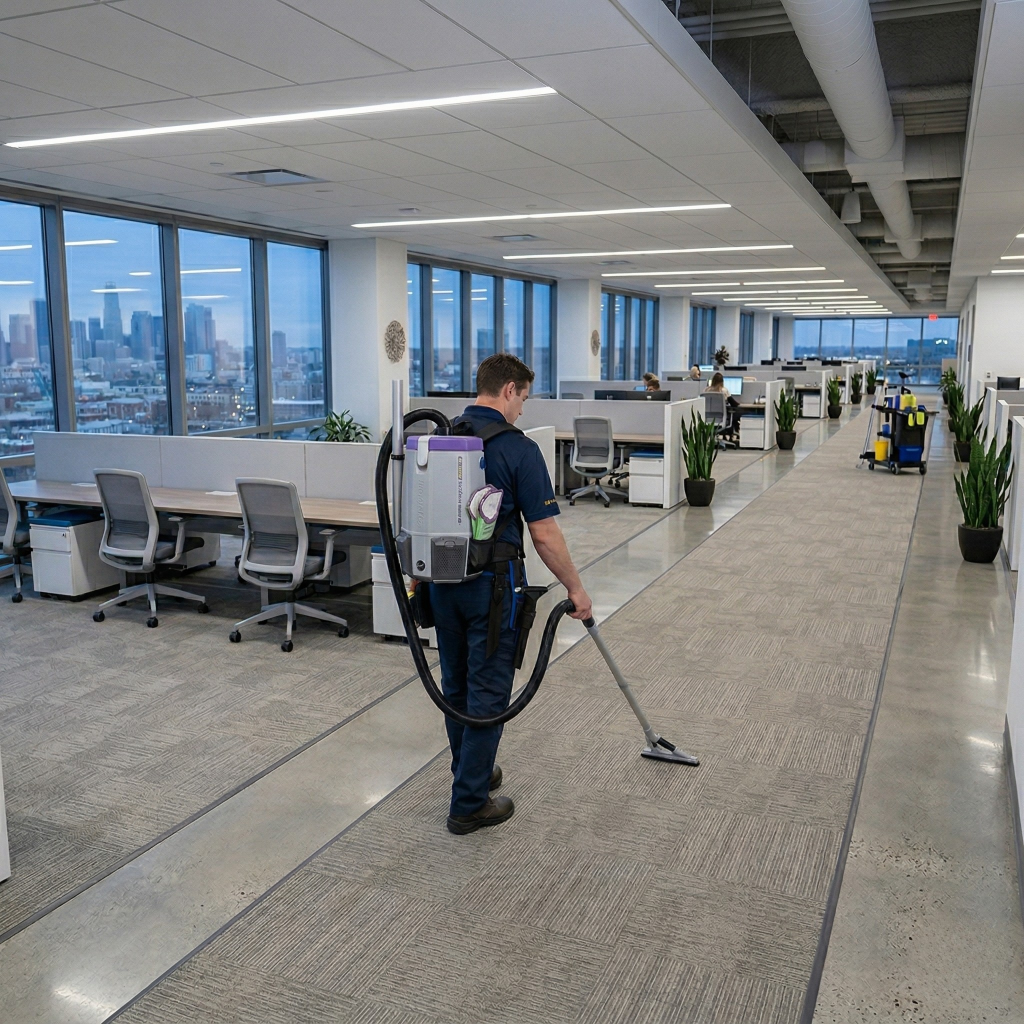
The reason comes down to ergonomics and maneuverability. A backpack vacuum positions the motor and collection unit on the operator’s back, freeing both hands to guide the floor tool. The operator can move continuously in a natural walking motion rather than stopping to reposition a wheeled unit. Transitions between carpet and hard surfaces, around furniture, and through doorways are faster because there is nothing to drag or maneuver behind the operator.
For a facility cleaning staff running a nightly or weekly program, that speed advantage translates directly into labor hours saved. In practical terms, one operator with a backpack vacuum can cover a floor area that would require two operators with upright vacuums in the same time window. For building service contractors with hourly labor costs, or for in-house facilities teams managing staffing levels, this is a meaningful operational advantage.
Ergonomics and Staff Retention
Cleaning staff turnover is a persistent challenge in facilities management. The physical demands of the job contribute to that turnover, and vacuuming with a heavy upright vacuum — pushing it across carpeted surfaces, lifting it on stairs, bending to clean under furniture — adds to the cumulative physical strain of a shift.
Backpack vacuums are designed to distribute weight ergonomically across the shoulders, hips, and back. The harness systems on professional-grade units like the ProTeam Super CoachVac are adjustable and transfer most of the weight to the hip belt rather than the shoulders, significantly reducing fatigue over the course of a shift.
This matters for two reasons. First, less physical strain means less risk of musculoskeletal injury, which is both a human resources concern and a workers’ compensation cost issue. Second, a job that is physically easier to perform is easier to retain people in. Given the cost of recruiting and training new cleaning staff, equipment that reduces physical strain pays returns beyond the cleaning productivity gains.
Backpack Vacuum vs. Upright: A Direct Comparison
Both vacuum types have their appropriate applications. Here is how they compare on the metrics that matter most in commercial facilities.
Cleaning speed. Backpack vacuums cover 40% to 50% more floor area per hour in most commercial environments. Upright vacuums are competitive in narrow, linear spaces where the straight-line path advantage is reduced.
Filtration. HEPA-equipped backpack vacuums filter substantially more finely than standard upright vacuums. Upright vacuums with HEPA filtration exist, but they are less common and typically more expensive.
Maneuverability. Backpack vacuums have a clear advantage in tight spaces, around furniture, on stairs, and in any environment with irregular geometry. Upright vacuums are easier to use in wide-open, obstacle-free spaces.
Noise. This depends on the specific model, but many commercial backpack vacuums are designed with noise reduction in mind. Low-noise models, including the ProTeam 107102 and similar units, are suitable for daytime cleaning in occupied spaces.
Operator training. Backpack vacuums require an initial orientation to fit the harness correctly and establish efficient technique. This is a 20- to 30-minute investment that pays off quickly with productivity gains.
Upfront cost. Commercial backpack vacuums are generally priced in the same range as quality commercial uprights. The cost per cleaned square foot over the life of the unit is typically lower, factoring in the labor productivity advantage.
Choosing the Right Backpack Vacuum for Your Facility
ProTeam is the market leader in commercial backpack vacuums, and its line covers most commercial applications. Here is a quick guide to the right unit for common scenarios.
For large-area commercial and institutional facilities: The Super CoachVac or GoFit 10 provides the combination of filtration performance, tank capacity, and durability needed for high-volume cleaning programs.
For healthcare and infection control environments: Look for units with four-level HEPA filtration and low-exhaust designs that minimize the risk of dispersing fine particles during operation. ProTeam’s healthcare-specific models are designed for these environments.
For occupied facilities and daytime cleaning: Low-noise models rated below 65 dB are suitable for office buildings, schools, and hospitality environments where cleaning often occurs while occupants are present.
For stairways and tight spaces: Smaller-capacity units with a short hose and lightweight design are easier to handle in confined vertical spaces.
Your LBC sales rep can walk through the specific ProTeam model that fits your facility size, floor type, and cleaning frequency. We can also arrange a demonstration so your team can evaluate the ergonomics and filtration firsthand before making a purchase decision.
Maintaining Your Backpack Vacuum for Long-Term Performance
Like any cleaning equipment, a backpack vacuum performs best when it is maintained consistently. A few habits extend equipment life and sustain filtration performance.
Empty the bag or canister before it reaches full capacity. A vacuum operating with a full bag has reduced suction and puts more stress on the motor. Empty at 75% capacity as a rule of thumb.
Inspect and replace filters on schedule. HEPA filters have a service life. Operating with a clogged or degraded HEPA filter defeats the equipment’s air-quality purpose and reduces suction performance. Follow the manufacturer’s replacement schedule.
Inspect the hose and floor tool connections regularly. Air leaks at connection points reduce suction at the floor tool and can allow unfiltered air to bypass the filtration system.
Check the harness hardware. Buckles, clips, and adjustment points are subject to regular stress during use. Replace worn components before they fail.
Train staff on correct harnessing. A backpack vacuum fitted incorrectly — with the weight sitting too high on the back and no hip engagement — is uncomfortable and increases fatigue. A properly fitted unit distributes weight correctly and is comfortable to wear for a full shift.
Frequently Asked Questions
How long does it take to train staff on a backpack vacuum? Most operators can be productive with a backpack vacuum after 20 to 30 minutes of initial instruction. A brief orientation covering harness fitting, wand technique, and best practices for transitioning between surfaces is sufficient for most staff.
Can backpack vacuums be used on hard floors as well as carpet? Yes. Most commercial backpack vacuums include a floor tool suitable for hard surfaces, and many offer multiple tool options for different surface types. For facilities with mixed hard and carpeted surfaces, backpack vacuums are actually more efficient than upright vacuums because transitions between surfaces are faster.
How does the HEPA filtration on a backpack vacuum compare to my HVAC system? They serve different functions. Your HVAC filters particulate matter from the air already in circulation. Your vacuum is the primary tool for removing dry particulate from floor surfaces before it becomes airborne. Both matter for indoor air quality, and they work together. A vacuum with poor filtration introduces particles into the air that then circulate through your HVAC system.
What is the typical lifespan of a commercial backpack vacuum? A well-maintained commercial backpack vacuum from a quality manufacturer like ProTeam should provide five to ten years of service under normal commercial use. Proper filter replacement and regular maintenance significantly extend equipment life.
Are backpack vacuums suitable for large open-plan office floors? Yes, and this is actually one of the environments where the productivity advantage is most pronounced. An operator can walk continuously across a large open floor without repositioning, covering the area significantly faster than an upright vacuum would allow.
Commercial backpack vacuums are not a niche product for specialized environments. They are the most efficient, highest-performing vacuum solution available for most commercial facilities, and the combination of labor savings, filtration performance, and ergonomic benefits makes them the right choice for facilities teams looking to clean better in less time.
As allergy season gets underway and facility managers review their cleaning programs for the warmer months ahead, it is worth taking a hard look at the equipment your team is using to vacuum. If it is an aging fleet of upright vacuums, the upgrade math is usually straightforward.
Leonard Brush & Chemical carries the full ProTeam backpack vacuum line, along with replacement bags, filters, and accessories. Our team is available to answer questions about specific models, arrange a product demonstration, or help you evaluate whether a backpack vacuum program makes sense for your facility size and cleaning frequency.
Call us at 502-585-2381 or visit leonardbrushandchemical.com to talk to an equipment specialist.